Showing posts with label school abroad. Show all posts

Tuesday, 26 April 2016

Marine Engineering


The three major aspects of Engineering in Maritime..


Naval Architecture, and Naval, Marine and Ocean Engineering are fast growing and dynamic fields with plentiful opportunities that are improving as people turn to the oceans for resources such as food, transportation and energy.
These engineers must be creative and visionary to see the potential to use transportation and the oceans effectively. Government, industry and academia are hungry for experts and researchers to develop new processes and systems to explore and travel the ocean with minimal or no danger to its habitat and environment. Marine structures, vessels and ocean systems are unique because only a small number of each design is built, they are very large and complex, and they operate in this environment.
Anything that operates in this environment has special design requirements relevant to sea-keeping, capsizing, station-keeping, and random motions and loads in a hostile environment. Due to this uniqueness, the manufacturing is often more challenging and expensive.
The impact of Naval Architecture, Marine and Ocean Engineering is far-reaching and greatly enhances our quality of life. For example:
---74% of the world’s trade is carried by ship.
---95% of the U.S. international trade is transported by ship.
---55% of the U.S. population lives within 50 miles of a coastline.
---60% of the U.S. energy is imported by ship.
Naval Engineering:
Naval engineers work on naval vessels. A naval vessel is one of the world’s largest and most complex engineered systems. It’s much more complicated to design a navy ship than almost any other form of transportation or structure. Not only is the ship critical to national defense but it has to move through the water similar to other boats and amphibious vehicles and enable a crew of hundreds to live aboard it for extended periods of time. Engineers in this field must always balance cost, new technology, hull design, materials and all of the systems aboard such as the weapons management, electronics, HV/AC, propulsion, ventilation, sleeping quarters, galley, head, etc. The real trick for the Naval Engineer is to pull all of these pieces together.


Naval architects are engineers who design all kinds of watercraft or anything that can be used as transportation on water. This may be a ship, boat, submarine, seaplane, icebreaker or offshore drilling platform. The vessels may be used for recreation, transportation, work or by the Navy and can be big or small. They may be powered by sails, nuclear power or some other propulsion system.
Marine environments can be hostile and unpredictable. One minute the seas are calm and the next can be a white knuckle ride as the waves pound the side of your boat or seagoing vessel. This unpredictability provides a challenging frontier for the naval architect.


Marine Engineering:
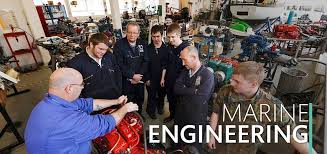


Naval architects may build the frame or structure of a boat but marine engineers are needed to design all of the internal power and machinery systems of the boat. Without marine engineers, the boat would have no engine, electronics, hydraulics, lighting, refrigeration, or controls. To be a good marine engineer, you must be very versatile, creative and open to learning. Marine engineering is an exciting career because every boat or ship is different and you will be responsible for every system on board. Almost every boat needs an engine, propeller, steering, transmission, pumps, electrical systems, etc. Marine engineers make it happen.
They know a lot about many different kinds of vessel systems and controls. They give millions of people the ability to have fun on jetskis, small sailboats, or vacation cruises as well as enabling the military to race across the oceans, clean oil spills or rescue other boaters in distress.

Ocean Engineering:


Every instrument, every device and every process in an ocean environment is the creation and responsibility of ocean engineers. The ocean environment is very corrosive, volatile and often unpredictable. Waves are never-ending and the devices or gear that are used to explore the environment must be able to withstand high winds, waves and salt-water. One of the great things about ocean engineering is that many different types of engineers can be a part of the solutions needed for ocean infrastructure, research and utilization.
Ocean engineering integrates disciplines such as materials science and mechanical, civil, computer, software, marine, chemical and electrical and electronics engineering. In addition to creating underwater robots (ROV’s), they also develop underwater structures, oil rigs, buoys for data collection, and they are hard at work developing ways to capture the energy of waves and turn it into electricity. city.
They develop transportation systems, plan new uses for waterways, design deep-water ports, and integrate the land and water transportation systems and methods. They are concerned with discovering, producing, and transporting offshore petroleum as well as developing new ways to protect marine wildlife and beaches.


Tuesday, 12 April 2016

BS in Architecture in the Philippines


The Bachelor of Science in Architecture (BSArch) is a 5-year college degree intended for people who wish to pursue a career in Architecture. Architectural education provides students with knowledge and skills in planning, designing and constructing buildings taking into account the principles of utility, strength and aesthetics.

The BS in Architecture curriculum comprises of CHED-mandated general education courses; technical subjects in Math, Science and Basic Engineering; and professional Architecture courses presented thru classroom lectures, laboratory classes and studio design activities.

Keeping abreast with the current trends in Architectural industry, most schools provide technologically upgraded studio facilities for the study of computer aided designs.

The BS in Architecture program in the Philippines is offered in ladder type curriculum:

The first three years put emphasis on providing opportunities for the students to draw and design with a sense of quality and technical expertise; to develop visual perception, and to understand construction as a means of communication of principles. Upon satisfactory completion of the prescribed courses at certain level, students will be granted Certifications for the technical skills acquired, such as Certificate in Drafting Technology; Certificate in Building Technology and Utilities; and Certificate in CADD.

The last two years are used to plan actual projects and explore the more detailed spatial and visual considerations and to gain knowledge in computer science as applied to Architecture. Special emphasis is given on the importance of research as evidenced by the thesis requirement for the course. Additionally, the knowledge and understanding of the ethical guidelines of the profession is a significant component of the program. (source)


Is Architecture a profession?

Architecture is a profession. A graduate of BS in Architecture who passed the Architecture Licensure Examination is called an Architect. An Architect is technically defined as a person professionally and academically qualified, registered and licensed under Republic Act No. 9266 with a Certificate of Registration and Professional Identification Card issued by the Professional Regulatory Board of Architecture and the Professional Regulation Commission.

What are the admission requirements for BSArchi?
 

Requirements at each school may differ, but these are the common requirements:

    Must be a high school graduate.

What skills will help you succeed in this course?

    Artistic talent and Drawing skills
    Technical Skills – the ability to accomplish mathematical, engineering, scientific or computerrelated duties
    Creativity
    Analytical skills – the ability to visualize, articulate, and solve problems.
    Basic Mathematical skills – the ability to solve and use different computational methods
    English skills – the ability to read, write and converse in English as most technical literature is in English.
    Interpersonal skills – will help you in studying together with classmates, doing group assignments and forming connections with friends and colleges.


How difficult is this course?
BS in Architecture is both interesting and challenging. Natural artistic talent plays a big part into it, as this profession requires a lot of drawing skills and creativity. Students are expected to draw extensively and build chipboard models or building prototypes. The course also requires numerical proficiency used for cost estimation, surveying, structural load and other mathematical computations. Production of the required drawing projects and presentation materials require lots of hard work, patience and careful attention to details. But since Architecture is not just a science but also an art, a passionate student who overcomes these challenges might really enjoy studying Architecture.

How long does it take to complete BS in Architecture in the Philippines?

Normally, the BSArchi takes 5 years to complete. Universities which go by the Trimester school calendar require less time to finish the course.

On The Job Training / Internship

CHED Memorandum Order no.61 mandates that Schools of Architecture shall have an active and organized program for on-the-job and diversified training for its students which shall include: assistance in organizing student employer interviews; maintenance of a job-available card file with an index of potential local employers; and if needed, assistance to employers, and fast transfer of students' academic transcripts to speed up the employment process.


Career opportunities for BSArchi graduates

    Jobs for licensed Architects

        Entry Level jobs
        Jobs requiring no prior to minimal level of experience:
            Junior Architect – works in a construction firm and are involved with designing new buildings, extensions or alterations to existing buildings, or advising on the restoration and conservation of old properties.
            Junior Design Architect – works under the senior design architect and helps in rendering and building proto-types to demonstrate design concepts
            Computer-Aided Design (CAD) or Computer-Aided Design and Draft (CADD) Architect – uses CAD systems application to create electronic versions of the technical drawings and design plans for buildings and machinery.
            Building Surveyors – often work on preventative measures to keep buildings in good condition and look to make buildings sustainable.

        Advanced Positions

        Require years of extensive experience and practice:
            Principal Architect – a licensed architect who owns an architecture firm or one who shares an ownership interest with the other architects in the firm.
            Architectural project manager – work closely with the construction project manager and coordinate the work of the design team and manage communication with the client. The issues of budget, scheduling, and quality-control are the responsibility of the Project Manager in an architect's office.
            Architectural Technologists are architectural specialists who turn the concept into reality in the completed construction. Concerned with the technical side of design, ensure that an attractive functional building performs successfully by making sure that the right materials are used and that building regulations are met.
            Building Conservation Officer – advises on and promotes the protection of the historic environment and, in particular, its long-term care, preservation and enhancement of enlisted buildings within conservation areas.
            Senior Design Architect – have experience in strategic master planning, and is responsible for managing assigned architecture projects, including development of concept drawings and designs, and meeting client expectations, while ensuring work is within project scope, meets the project schedule deadlines and is within budget.
            Architecture Researcher – researches, designs and develops solutions to highly complex and technical issues, designs system architecture, workflows, data flows and databases; recommends solutions to highly complex problems to provide technical direction on systems analysis, design, development and testing.
            Academician – architects who are faculty members, instructors, and professors in an institution that offers Architectural course
   

Source: finduniversity.ph

Thursday, 7 April 2016

BS in Marine Engineering in the Philippines

BS in Marine Engineering in the Philippines

The Bachelor of Science in Marine Engineering is a 4 year degree program that centers on the construction, operation, and maintenance of different kinds of marine vessels such as cargo ships, cruise ships, fishing boats, battleships and submarines.

This program aims to provide students with the knowledge and skills that will enable them to operate and maintain the different machineries installed in marine vessels, including the propulsion plant, adjunct and auxiliary machinery, electrical and refrigeration systems.

Some of the subjects included in this program are:
  • Engine Watchkeeping
  • Ship Construction and Ship Stability
  • Mechanics and Hydrinechanics
  • Marine Power Plant
  • Fuel Oils and Lubricants
  • Ship and Ships Routine
  • Auxiliary Machinery
  • Machine Shop
  • Heat Balance
  • Engineering Physics
  • Electro Technology
  • Analytic Geometry with Solid Geometry
  • Spherical Trigonometry
  • Plane Trigonometry
  • Integral Calculus
  • College Algebra
  • General Chemistry
  • Basic Safety
  • Marine Pollution and Prevention

The Bachelor of Science in Marine Engineering is taught through classroom-based frontal instructions as well as hands-on trainings usually conducted in special laboratories and a one year apprenticeship aboard a ship.

Is Marine Engineering a profession?


Marine Engineering is a profession. A graduate of BS in Marine Engineering needs to pass the Licensure Examinations for Officer-in-Charge of an Engineering Watch, Second Engineer or Chief Engineer before practicing as a marine engineer. In general, a Marine Engineers job includes the maintenance, operation and installation of different machineries and systems in the vessel, as well as the development and construction of marine vessels.


What are the admission requirements for BSME?


Requirements at each school may differ, but these are the common requirements:
  • Must be a high school graduate.

What skills will help you succeed in this course?


  • Mathematical Skills – you need to have advanced computational skills and be equipped with a strong foundation of mathematical concepts in order for you to solve problems
  • Analytical Skills – the ability to identify the kinds of data that are actually important and figure out how to solve problems
  • Critical Thinking – the ability to think logically and make use of reasoning in evaluating the different solutions or approaches to a problem
  • Technical Skills – the ability to perform various tasks related to engineering, mathematics, science, and technology. Moreover, this can also refer to the ability to operate various equipments and software.
  • Mechanical Skills – this skill is important because this field involves the development, construction, operation, and maintenance of different machineries and mechanical systems used in a marine vessel.
  • Endurance – this refers to the ability to withstand difficult situations, hardships, or stress. This skill is important because working as a marine engineer involves difficult tasks and entails being away from your family for long periods of time.
  • Creativity – the ability to come up with unique concepts and designs for marine vessels as well as their component parts. This skill is also needed in creating the models and prototypes of the conceptualized designs that are usually presented in class.
  • Interpersonal Skills – the ability to communicate and interact harmoniously with other people will definitely help you work on group projects and activities with your classmates.
  • English Skills – the ability to read, write, and communicate well in English is necessary because most of the technical literature and required reading materials are in this language.

How difficult is this course?


Just like other Engineering courses, BS in Marine Engineering is not that difficult but It involves a lot of technical, scientific, and mathematical concepts.


How long does it take to complete BS in Marine Engineering in the Philippines?


Normally, the BSME program takes 4 years to complete. However, some schools which apply the trimestral school calendar system do the program for a shorter period of time. 

The internship for BS in Marine Engineering takes a whole year to complete, so basically, this course involves three years of basic studies and one year of apprenticeship period. 

Apprenticeship Period


The apprenticeship period involves a 1-year internship aboard a ship in order to expose students to the practical applications of the concepts they learned in the classroom and laboratory activities. Some schools help the students find companies or organizations where they could work as an apprentice, while some give their students the freedom to find on their own. Moreover, some companies provide an allowance during this period, while others do not. 

Career opportunities for BSME graduates


  • Jobs for licensed marine engineers (board exam passers)

    • OIC of an Engineering Watch – this job entails working as an engine room personnel, maintaining a safe and economical sailing, supervising maintenance and repair work by subordinates, ordering of spare parts, as well as other tasks assigned by the Chief Engineer.
    • Second Marine Engineer – this job involves updating documentations (e.g., Machinery Maintenance Record Book; Engine Room Log Book; Lube Oil and Chemical Inventory), engine room management, and machinery maintenance (e.g., major repair works; round checks; emergency repairs).
    • Chief Marine Engineer – this involves acting as the head of the marine engineers in a ship and working closely with the captain. A Chief Marine Engineer is in charge of delegating tasks to its team to ensure the maintenance of the Engine Room, Oil and Chemical Inventory, as well as the inventory for spare parts.
    • Naval Engineering Officer – this job involves the development, operation, and maintenance of Philippine Navy ships and other marine vessels.
    • Coast Guard Engineering Officer – this job entails ensuring that the marine vessels of the Philippine Coast Guard are working efficiently and are properly maintained.
  • Jobs for those who have not yet passed a board exam

    • Engineering Cadet – this job involves assisting in the engineering operations of the ship including the operation and maintenance of machineries. The engineering cadet usually reports to the second engineer.
    • Apprentice Engineer – this job involves aiding the licensed engineers with the different operations including the repair of the marine vessels and equipments, as well as the maintenance of the engine room.
    • Engine Cadet – this is one of the most junior personnel in the Engineering department of the ship. This job involves taking orders from higher engine officers and assisting the engine officers in the different tasks related to the engine room and other machineries.
    • Engine Boy – this job entails being familiar with the different components of the machineries. An engine boy must know how to operate these machines, conduct repairs, and maintain the machines to ensure that they are working efficiently.
    • Oiler – an oilers main duty is to oil or provide lubrication to the machineries in the marine vessel, so they will work smoothly. Aside from that, they also operate and maintain the propulsion system in the vessel.
    • Wiper – also called the cleaner, a wipers job is to clean engine spaces as well as machineries, and assist the engineers or other higher officers as directed.
    • Motorman – the motormans job involves making sure that the all the motors and overall machinery in the vessel are always working properly. Their job does not only involve ensuring that the machines and motors are properly maintained, but instead, they must also provide assistance to other crew members and officers.
    • Procurement Engineer – this job entails the review of the quality and costs of marine equipments, as well as the schedule of deliveries of these purchases.
  • Career Opportunities Abroad

    There are job opportunities abroad for Filipino Marine Engineers in countries such as Bahrain, Qatar, United Arab Emirates, Saudi Arabia, Japan, United States, Germany,Singapore and Kuwait.

source:  http://www.finduniversity.ph/majors/bs-in-marine-engineering-philippines/

Reviews of BS in Marine Engineering graduates:


M. O.
Studied BS in Marine Engineering
at John B. Lacson Colleges Foundation - Bacolod , Bacolod City
Graduated: 2014

Why did I choose this course:
I chose this course for three reasons:
- High employment rate
- High paying job
- And a chance to travel the world

About my college education:
Everything is just easy if you are eager to learn and pass the subjects. There are hindrances and difficulties along the way but if you are determined and just exert your very best, you can be successful in any career you have chosen. I learned that we should have self-discipline in everything we do and be flexible in any aspect. In my profession, I always enjoy the free travel that I experienced.

My current job:
We are tasked for the maintenance and operation of all the engines and ship's equipment. Just imagine working inside a very huge engine of a car.

Am I using what I learned in college:
Most of the professional subjects such as Power Plant 1,2 and 3, Auxiliary Machinery 1 and 2, Engine Watchkeeping, Basic Safety, Marine Pollution and Prevention and others are very useful in giving me ideas and a bird's eye view of the career. They had helped me but most of the things are learned through experience.

How long did it take to find a job after graduation:
I was a company-sponsored cadet during my college years. So after graduation, I only needed to pass the board exam and report to the company.

Do I recommend studying BS Marine Engineering:
Of course. It has a high employment rate and a lucrative job. Aside from that, you can have a chance to travel the world.

Advice to people who are thinking of studying this course:
Have self-discipline and learn to adjust in any changes which you experience along the way. May it be with the weather, season, time and the people you work with. Be flexible and always be eager to learn. 

J. P.
Studied BS in Marine Engineering
at VMA Global College , Bacolod City
Graduated: 2012

Why did I choose this course:
To become a successful marine chief engineer someday, and of course to help and improve my family financial needs when I get hired for a job.

About my college education:
BS marine engineering, sounds hard, but there's nothing wrong on trying, patience is virtue, prayers and discipline one of the most important learning, that i have learned, which is very much useful when I get on-board a foreign vessels.

My current job:
Has finished already my 12 months contract on-board a vessel as an engine cadet.

Am I using what I learned in college:
As iv'e said, on the top, prayers, patience is virtue, and discipline, discipline on how to respect yourself and of course with ships-mates especially to the officers and crew.

How long did it take to find a job after graduation:
Graduated March 2012, and boarded international vessels December 2012, so maybe more than 9 months.

Do I recommend studying BS Marine Engineering:
Starting salary as a cadet its 365 dollars, and as a chief engineer its 8,000 dollars, depends on the company and the principal agencies.

Advice to people who are thinking of studying this course:
Study hard, aim high, don't loose hope, give your best, and of course prayers. 

Nolyd S. Alonzo
Studied BS in Marine Engineering
at Zamboanga City State Polytechnic College , Zamboanga City
Graduated: 2010

Why did I choose this course:
Because I thought that's where I belong.

About my college education:
I learned a lot about math, physics and other relevant to apply on ship.

My current job:
My current job is a 2nd marine engineer on-board an international vessel.

Am I using what I learned in college:
About practical engineering and calculations.

How long did it take to find a job after graduation:
After graduation I took up a board exam and there after I already been on-board. after I completed my requirements it took 4 months.

Do I recommend studying Bs in Marine Engineering:
Now a days I recommend it to people who want to change their life accordingly.

The salary was of fresh graduates can be at-least 25-30k and the most experienced officers may get 400-500k.

Advice to people who are thinking of studying this course:
To study hard and develop your skills and stamina. It's very difficult indeed if already on the real ship.


Source: http://www.finduniversity.ph/testimonials.aspx?maj=324

Wednesday, 14 October 2015

A LISTS OF COURSES AVAILABLE IN THE PHILIPPINES...

B.S. in Medical & Healthcare
Nursing
Doctor of Medicine
Caregiving
Dentistry
Health Education
Healthcare Administration
Medical Laboratory Science
Medical Technology
Midwifery
Nutrition
Occupational Therapy
Optometry
Pharmacy
Physical Therapy
Public Health
Radiologic Technology
Veterinary
B.S in Business courses:
Business Administration
Accountancy
Marketing
Entrepreneurship
Economics
Finance & Banking
HR
Management
B.S in Communication & Info. Science
Communications
Journalism
Library & Information Science
Public Relations
Visual Communication
B.S in Computer Science
Computer Science
Information Technology
Computer Engineering
Information Management
B.S in engineering courses:
Civil Engineering
Mechanical Engineering
Computer Engineering
Chemical Engineering
Electrical Engineering
Electronics & Commun. Eng.
Environmental Engineering
Geodetic Engineering
Industrial Engineering
Marine Engineering
Metallurgical Engineering
Mining Engineering
B.S in Technology & Technicians
Aircraft Maintenance & Tech.
Automotive Technology
Computer Technology
Drafting Technology
Electrical Technology
Electronics Technology
Food Technology
Garments & Apparel
Industrial Technology
Mechanical Technology
Refrigeration & Air Cond.
B.S in Tourism & Hospitality
HRM
Tourism
Cruise Line Operations
Culinary Arts
Hospitality Management
Travel Management
B.S in Transportation courses:
Aviation
Marine Transportation
B.S in Science courses:
Biology
Biochemistry
Chemistry
Ecology
Environmental Science
Geology
Meteorology
Microbiology
Physics
Physiology
Statistics